

Introduction
There’s something undeniably special about a full moon in December. Perhaps it’s the way it glows through frosty air, or how it seems to hang lower and larger in the winter sky. This year, that magic hits a crescendo: on December 15, 2025, we’ll see the Cold Moon-a full supermoon that coincides with the longest night of the year, just days before the winter solstice.
As a science writer and amateur astronomer who has followed lunar cycles for a decade-plus and once wrapped up with hot cocoa to photograph a lunar eclipse in -10° weather, I have seen how moments like these tie us together-to nature, to history, and to each other.In this post, we will look at:
- What makes the December 2025 Cold Moon a supermoon
- Why it matches the year’s longest night
- The rich cultural and historical roots of the “Cold Moon” name
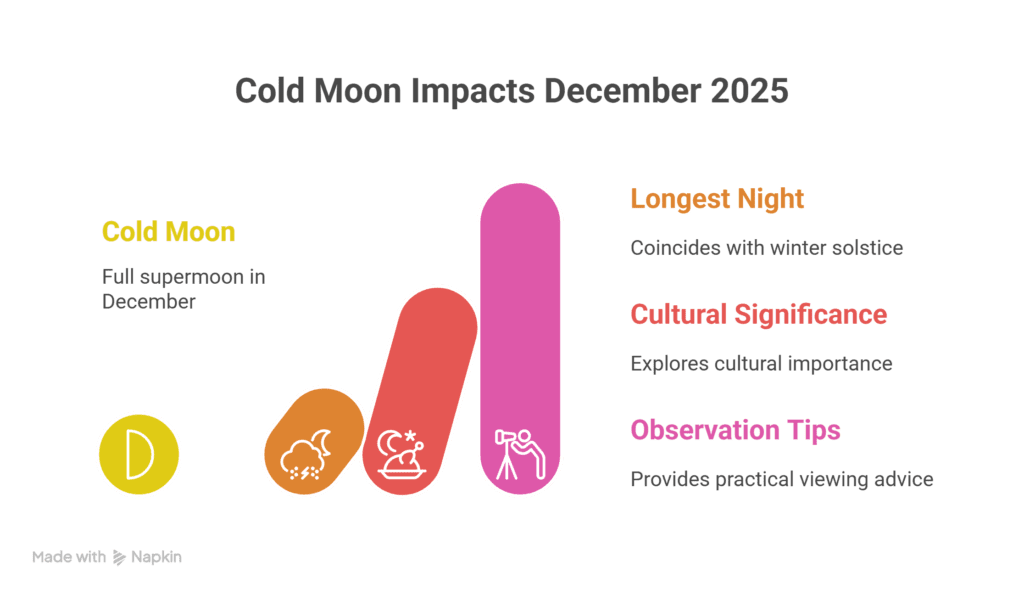
Practical tips to observe the Cold Moon-no telescope needed
Why this Cold Moon celestial event matters beyond just pretty skies
What Is the Cold Moon-And Why Is It a Supermoon in 2025?
The Name “Cold Moon” comes from Indigenous and Colonial Traditions
Long before modern calendars, many Indigenous nations of North America tracked time by lunar cycles. In the Mohawk and other Algonquian-speaking peoples’ reckoning, the December full moon is often called the Cold Moon – reflecting the deep freeze that settles in this time of year. Some also knew it as the Long Night Moon, thanks to its appearance during the year’s extended darkness.
These names were adopted by colonial settlers and today are part of our shared cultural astronomy—reminders that the sky has always been humanity’s first clock.
“The Cold Moon isn’t just folklore–it’s practical sky-wisdom passed down through generations,” says Dr. Annette Lee, an astrophysicist and founder of Native Skywatchers.
December 2025’s Cold Moon Is Also a Supermoon
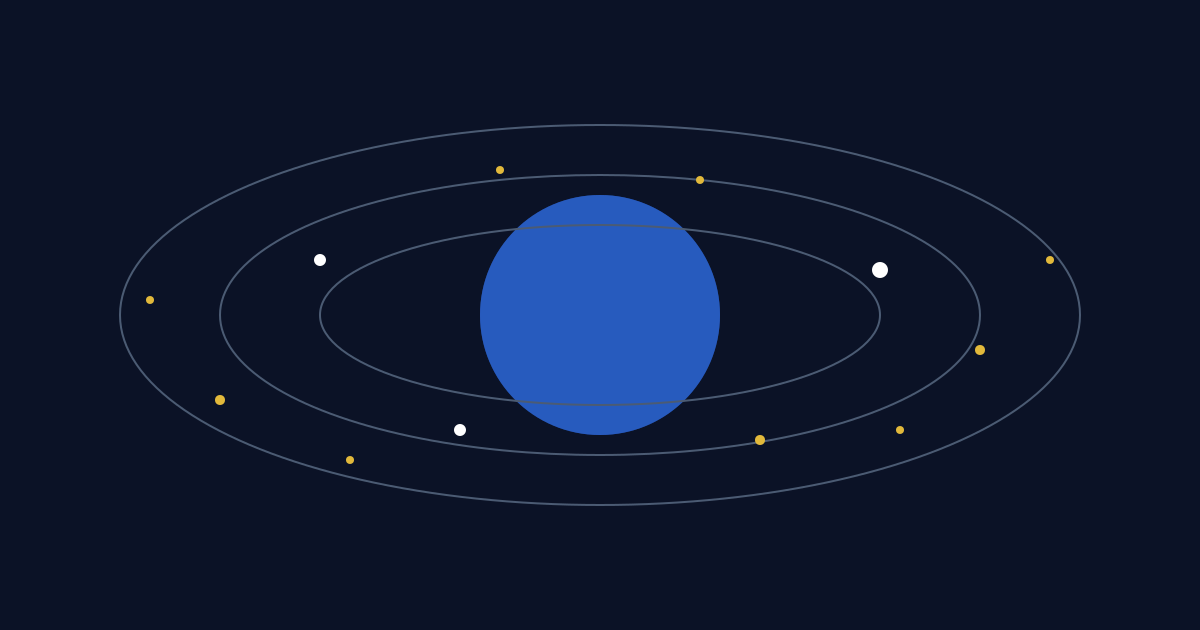
A supermoon occurs when a full moon coincides with lunar perigee—the point in the Moon’s orbit when it’s closest to Earth. At perigee, the distance is about 226,000 miles, compared with an average 239,000 miles. This makes it appear as much as 14 percent larger and up to 30 percent brighter than a micromoon (full moon at apogee).
In 2025, the Cold Moon reaches peak fullness on Monday, December 15 at 3:48 a.m. EST—just 3 days before the winter solstice (December 18, 2025), which marks the longest night and shortest day of the year in the Northern Hemisphere.
That’s timing few of us will ever experience. Supermoons pop up 2-4 times a year, but one falling so close to the solstice-and meriting that “Long Night Moon” nickname-comes around once every few decades.
Why the Longest Night + Full Cold Moon Feels So Powerful
That’s the magic of this pairing:
Extended darkness = more time to see the moon
Winter’s clear, dry air = less atmospheric distortion = sharper views
Low moon angle = dramatic “moon illusion,” where it appears huge near the horizon
Astronomically, it’s not actually bigger-but your brain compares it to trees and buildings, tricking you into awe. And honestly? That’s half the fun.
How to Best View the December 2025 Cold Moon
You don’t need any fancy gear-just clear skies and timing. Here’s how to make the most of it:
Best Times to View
Full Moon, December 14 (at evening): The moon is biggest when near the horizon, which makes it a great time for pictures.
Peak fullness: Early morning December 15 (3:48 a.m. EST), but it’ll look full all night.
Solstice proximity: The nights of Dec. 15–18 offer the darkest, longest backdrops.
???? Where to Look for the Cold Moon????
Face east at sunset to catch moonrise.
The moon will travel south to west, setting around sunrise.
Photography Tips (Even on Your Phone)
Use night mode or a manual camera app
Rest your phone on a stable surface
Include foreground interest: trees, rooftops, snowscapes
Pro tip: Supermoons are brighter, so avoid long exposures unless you want a white blob!
Cultural Significance Around the World by the Cold Moon
While North American traditions call it the Cold Moon, there are other cultures that mark this time differently: Chinese tradition: Full moon usually falls in the 11th lunar month and is a time for quiet reflection and the honoring of ancestors.
European folklore: Ancient Germanic and Norse names include Winter Moon or Snow Moon, a time to huddle indoors and tell stories. Modern Pagan/Wiccan practice: The Cold Moon is connected to introspection, release, and preparing for rebirth at the solstice. This cross-cultural resonance reminds us that humans everywhere have looked up and found meaning in the same moon.
Will It Really Be the “Longest Night”? Yes–if you are in the Northern Hemisphere. In 2025, the winter solstice falls on Thursday, December 18 at 10:03 a.m. EST. That means: December 17–18 is the longest night – about 15 hours of darkness in mid-latitudes like New York or Paris.
But since the Cold Moon peaks just days before, it will dominate that extended night sky, appearing nearly full on the actual solstice night too. So though the very longest night is Dec. 17–18, the Cold Moon on Dec. 14–15 provides the brightest, most dramatic lunar display of the whole dark season.
Conclusion
A Celestial Pause in a Busy Season In a month often crowded with holiday to-do lists, the Cold Moon offers something rare: a quiet moment to look up. Whether you’re sipping tea by a window, walking your dog under starlight, or sharing the sight with kids, this supermoon connects us to rhythms far older than shopping malls or calendars. It’s also a gentle reminder that after the longest night, the return of light will surely follow. The solstice is that turning point, days slowly lengthen again. So mark your calendar for December 14–15, 2025. Step outside. Breathe in the cold air. And let the Cold Moon remind you how small—and how wondrous—we all are under the same sky.
Want to explore the cosmos? Click here