

Instroduction
Imagine walking through a forest, on your phone, getting coffee, or perhaps teaching your kid to tie his shoes. Let’s see, all these simple human moments are from just 1,280 people who clung to life nearly a million years ago at one of the harshest climate crises on earth, and made all of our genes.
It sounds like science fiction, but it isn’t. A new generation of scientists has undergone a massive population demise and has published a paper in Science (2023) that has shown that people in our past were on the brink of extinction for nearly 100,000 years. This “genetic bottleneck” reduced our numbers, and could have changed who we are today, from our brain structure to our social instincts.
As someone deeply intrigued by human origins, and indeed, having spent many late nights munching on paleogenomics papers with a cup of chai, I’m excited to help explain what this discovery says – not just for scientists, but for all of us. Because this isn’t just ancient history. It’s the story of us.
What Is a Genes Bottleneck—and Why Does It Matter?
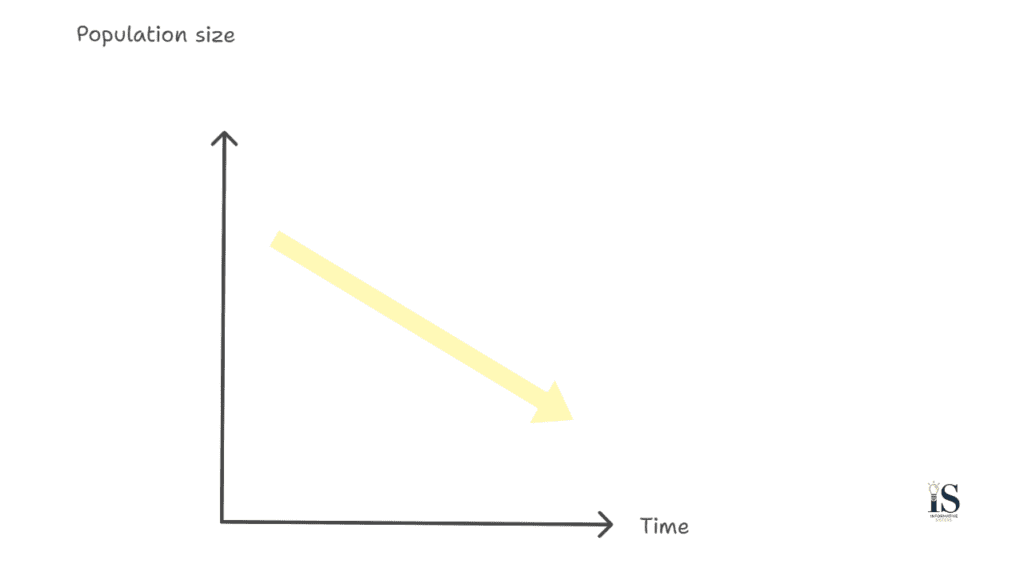
The phenomenon of a genetic bottleneck is when a species is drastically reduced in size by reducing population size which has the effect of radically changing genetics. Imagine pouring a burgeoning bog of genetic information through a narrow funnel but only a few pass through.
In the case of early humans:
Timeline: 900,000 years ago.
Duration: 117,000 years.
Breeding populations: Compared to an estimated 1,280 individuals.
Explains why modern humans are less diverse than chimpanzees or gorillas, though our population in the world now exceeds 8 billion.
“This bottleneck may explain why humans are so poorly genetically diversified among great apes…It was like our species got a reset” says Dr. Wangjie Hu, coauthor of the 2023 study.
The Climate change that made genes
So, what almost wiped us out?
It seems like crazy climate stuff during the Early-Middle Pleistocene thing – long ice ages, crazy cold, and dry times in Africa and Eurasia. Fossil records have a gap in human stuff from 900,000 to 700,000 years ago. It’s the “Middle Pleistocene Gap.” Pollen and dirt samples show huge changes in plants, turning good land into deserts. Few supplies, broken-up living spaces, and no farms meant surviving was super hard. But somehow, 1,280 people made it.
How Did They Do It? Smarts, Working Together, and Fire😅
This is where it gets cool. They weren’t just waiting to die but were making stuff work. We don’t have much proof from that exact time because of the fossil gap. However, we know from a bit later that early humans knew how to: Use fire well (Wonderwerk Cave in South Africa, about 1 million years ago) Make good stone tools Maybe had early language Most of all, they probably helped each other. Anthropologist Robin Dunbar says people started hanging out in bigger groups, which suggests stronger friendships helped when things were tough. Sharing food, helping the weak, teaching each other were very helpful. “Staying alive wasn’t just about being strong, it was about helping each other,” says Dr. Sarah Blaffer Hrdy, who studies primates. “Human babies can’t do anything themselves. We needed everyone to help.”
What It Means For Us: Fewer Genes, Bigger Brains?
What’s really interesting? This tough time might have made our brains grow faster. With fewer genes floating around, good changes could happen faster. Some think genes that helped with brains and getting along with others were picked as helpful during this time. Like: The FOXP2 gene (for language) looks like it changed fast back then. Brain size in Homo heidelbergensis, maybe from these people, began to grow after this time. Basically, almost dying made us smarter, which led to art, music, farming, and this post.
Why are these Genes Important Now?
Why should you care about something that happened a million years ago? It says two things:
- We’re not as tough as we think – we almost didn’t make it because of a tiny group. We are all related. Everyone alive comes from those 1,280 people.
- With climate problems, fights, and losing animals and plants, this story is a warning and a light. It shows how close we were to gone and how helping each other and being smart saved us.
Last Thoughts: Thanks to Those 1,280 Survived for our Genes
We have what they had. They were tough, and their story says that even when things are bad, there’s hope if we’re friends. So, when the world feels bad, remember that you’re here because humans can get through anything.
Want to explore more? Click here