
Introduction
Why a new theory about “rogue planets” is shaking up our history of the cosmos.
Imagine Earth about 4.5 billion years agoin the cosmos. It’s young, it’s hot, and it’s lonely.
But according to a wild new theory, it wasn’t alone for long. Floating just beyond our orbit was a mysterious world—not a sibling born from our own Sun, but a stranger. A rogue exoplanet, kicked out of its own star system and caught by ours. Then—crack. It slammed into Earth, vaporizing itself and scattering the debris that eventually knitted together to form the Moon.
It sounds like science fiction, right? Like something from a Marvel movie. But a growing number of astrophysicists are starting to take this idea very seriously.
I’ve spent 15 years as a planetary scientist trying to figure out how the Moon was made. I’ve stared at computer simulations until my eyes crossed, and I once spent three sleepless nights freezing in the Atacama Desert just to chase a meteor shower. I’ve watched the “origin story” of the Moon go from a neat, tidy textbook summary to a messy, fascinating cosmic detective story.
And this latest twist? It suggests our Moon might actually be an interstellar immigrant.
Here is the breakdown of why the old theory is crumbling, and why this “alien intruder” idea might actually be the answer.
The Plot Hole in the Cosmos “Giant Impact” Story
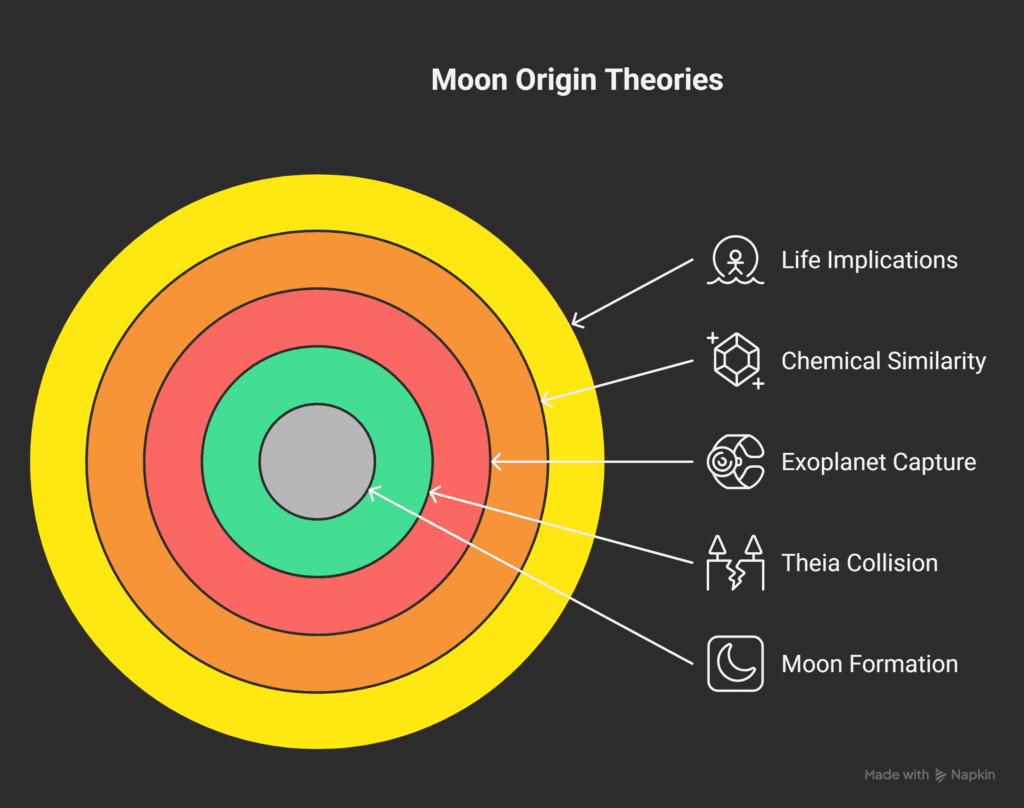
For decades, if you asked a scientist how the Moon formed, they’d tell you the Giant Impact Hypothesis. The story went like this: A Mars-sized planet named Theia (born right here in our solar system) crashed into baby Earth. The debris ring formed the Moon. Simple.
It was a great story—until we looked closer at the rocks.
That time when Apollo astronauts brought samples back from the Moon, scientists analyzed their chemical fingerprints (isotopes). The problem? The Moon rocks were almost identical to Earth’s mantle.
If Theia had formed somewhere else in the solar system—like Mars—its chemical signature should be different. Mars rocks look different than Earth rocks. Asteroids look different than Earth rocks. But the Moon? It looks exactly like Earth.
“It’s uncanny,” says Dr. Sarah Stewart, a physicist at UC Davis. “It’s as if the Moon is made of Earth… and nothing else.”
For the last ten years, this has been the itch that planetary scientists couldn’t scratch. The physics said “collision,” but the chemistry said “twins.”
Enter the Interstellar Drifter in the Cosmos
So, how do you fix this? In 2024, researchers from Harvard proposed a radical solution: What if Theia wasn’t from around here?

The theory suggests that Theia was a rogue exoplanet.
Space is a chaotic place. Whenever stars are born, they are usually packed together in tight clusters. In that gravitational mosh pit, planets get flung out of their home systems all the time. The theory goes that one of these castaways got snagged by our Sun’s gravity and ended up on a collision course with Earth.
Here is why this solves the chemistry problem: Stars born in the same cluster often have the exact same chemical makeup—they are “stellar siblings.” When this rogue planet came from one of the Sun’s long-lost sisters, it would be made of the exact same stuff as Earth.
So when it crashed into us, it didn’t leave a foreign chemical stain. It blended right in.
A Cosmos Lottery Win?
If this is true, it changes everything about how we see our planet.
We know that the Moon is crucial for life. It stabilizes Earth’s wobble (giving us seasons) and creates the tides (which likely helped kickstart life in ancient tidal pools).
When this theory holds up, it means Earth didn’t just get lucky with a local collision. It means an alien world traveled through the dark of interstellar space, arrived at the exact right moment, and sacrificed itself to give us a livable home.
I remember the first time I held a lunar sample at the NASA Johnson Space Center. It was a small, gray rock inside a protective case. It felt ancient. But thinking about it now, the idea that I might have been looking at stardust from a completely different sun, gives me chills.
In Conclusion, Is It True?
Science is rarely a straight line, and not everyone is convinced yet. We still need more proof.
Critics rightly point out that capturing a rogue planet is statistically rare (though not impossible). We need to run more simulations, and we definitely need more moon rocks. Hopefully, when the Artemis III mission lands near the lunar South Pole in a few years, we’ll get samples from deep inside the Moon that can settle the debate.
But whether Theia was a local neighbor or an interstellar vagabond, one thing is clear: Earth’s story is way more dramatic than we thought.
So, the next time you’re outside at night, take a second to look up at the Moon. It might not just be Earth’s child. It might be a messenger from the stars.
Want to explore the cosmos more? Click here