
Introduction
Close your eyes for a second. When you think of “space,” what do you see?
For most of us, it’s the grainy footage of Neil Armstrong, the roar of the Space Shuttle, or maybe the “meatball” logo on a blue flight suit. For decades, space was synonymous with America. It wasn’t just something we did; it was who we were. We were the pioneers.
But if you look up today, the picture is different.
Recently, a top NASA nominee dropped a truth bomb that made a lot of people in Washington uncomfortable: The United States’ dominance in space is no longer a sure thing. While we’ve been debating budgets and changing plans, China has been quietly, methodically executing a master class in space dominance.
I’ve been writing about space policy for 15 years—from the press bleachers at Kennedy Space Center to the boardrooms of aerospace startups—and I have to tell you: this isn’t just political posturing. The vibe has shifted. The warning lights are flashing, and we need to talk about why.
The “Space Race” Isn’t History—It’s the Morning Headlines
Race as a chapter in a history book, something that ended when the Soviet Union fell. But the race didn’t end; the players just changed.
This isn’t about Cold War bragging rights anymore. This is about economics, security, and who gets to write the rules for the next century.
China’s space agency (CNSA) isn’t playing around. In less than twenty years, they’ve gone from “also-ran” to “heavyweight contender.”
- 2019: They landed a rover on the far side of the Moon. Nobody—not us, not Russia—had ever done that.
- 2021: They launched their own space station, Tiangong. It’s up there right now, fully crewed, doing science while the ISS ages.
- The Future: By 2026, they plan to break ground on a lunar research base with Russia.

Meanwhile, our Artemis program—the one meant to put Americans back on the Moon—feels like it’s stuck in traffic. We’ve pushed the landing back to 2026, and if you ask engineers off the record, many think it’ll slip even further.
As Janet Petro, a recent NASA leadership nominee, put it: If we don’t get our act together, we risk ceding the Moon. She wasn’t trying to scare us; she was trying to wake us up.
Why Are We Falling Behind?
It’s frustrating because the problem isn’t a lack of American talent. Our engineers are still the best in the world. The problem is how we manage them.
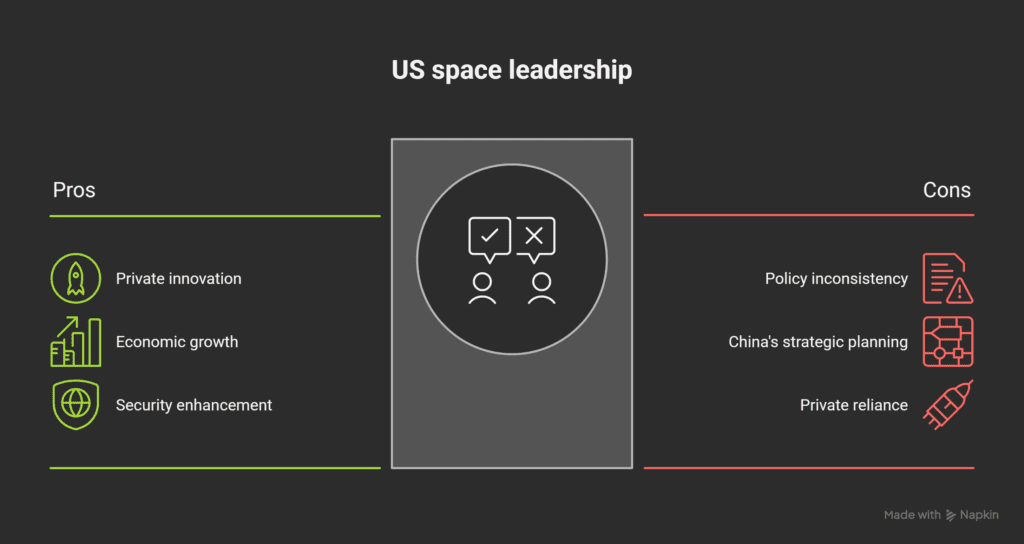
- 1. We Keep Changing Our Minds Imagine trying to build a house, but every four years a new architect comes in, fires the old crew, and changes the blueprints. That’s NASA’s reality. Bush wanted the Moon. Obama canceled that to focus on Mars and asteroids. Trump pivoted back to the Moon. Biden kept the Moon but tweaked the focus. Every pivot wastes billions of dollars and years of momentum. You can’t build a generational legacy on a four-year election cycle.
- 2. China Has a 50-Year Plan China doesn’t have this problem. They have a roadmap that spans decades. They don’t have to fight for funding every year or worry about a new administration scrapping their rockets. They just pick a goal and march toward it. They are the tortoise in this race—slow, steady, and relentlessly moving forward while the hare is distracted.
- 3. The Fragility of Private Space We love SpaceX and Blue Origin. Watching those boosters land themselves is like watching magic. But relying so heavily on billionaires adds a layer of risk. If a Starship explodes (which happens—it’s testing, after all), the entire U.S. timeline grinds to a halt. China has integrated their private sector directly into the state machine; they have redundancies that we don’t.
Why Should You Care? (It’s Not Just About Space Rocks)
You might be thinking, “Okay, but why does it matter if China gets to the lunar south pole first? It’s just a crater.”
It matters because space is the ultimate high ground.
- The Gas Station: The Moon holds water ice. Water can be turned into rocket fuel. Whoever controls those ice deposits controls the “gas stations” for the rest of the solar system.
- The Rules of the Road: Orbit is getting crowded. If China becomes the dominant power, they get to set the standards for debris, traffic, and communication. Do we want a space environment defined by an authoritarian regime, or by democratic values?
- Global Influence: We have the Artemis Accords, a coalition of nations agreeing to peaceful space norms. But China is actively courting countries in Africa and South America with their own deals. If we aren’t leading, they will.
A View from the Launchpad to space
I’ll never forget standing at the Kennedy Space Center in 2011, watching the final Space Shuttle launch, Atlantis, disappear into the clouds. The ground shook, the crowd cheered, and I felt this immense swell of American pride. But as the smoke cleared, I felt a pit in my stomach. What now?
That question has haunted the industry for over a decade. I’ve spoken to brilliant engineers who left NASA to work overseas because they were tired of the “start-stop-cancel” cycle. I’ve seen startups pivot to mining because they don’t trust the government to pave the way.
In Conclusion, The Clock Is Ticking for space
This isn’t a doom-and-gloom post. It’s a rally cry. The United States still has the best innovation engine on Earth. We have the spirit, the history, and the capability.
But we can’t coast on the glory of Apollo anymore.
We need Congress to commit to long-term funding that survives election cycles. We need to treat our STEM education pipeline like a matter of national security. And we need to stop looking at space as a luxury and start treating it as the next great frontier of human economy and influence.
The race against China isn’t about planting a flag. It’s about ensuring that the future of humanity among the stars is built on transparency, freedom, and hope.We can still win this. But we need to stop hitting the snooze button.
Want to continue exploring the cosmos? Click here