
Introduction
Zombie Comets, Solar Tantrums, and the Fungi That Loves Nukes just total chaos
A Field Guide to December 2025’s Weirdest Science News, a way through the chaos
Is it just me, or is the universe showing off this week? Which is making chaos
If your news feed is anything like mine, it’s currently a chaos of “The Sun is attacking us,” “A dead comet is alive,” and “Chernobyl has Fungi.” It sounds like the plot of a B-movie, but it is actually real life right now.
I’ve spent the last ten years trying to translate high-level physics into plain English (usually while waving my arms around at dinner parties), so I wanted to take a breath and unpack what is actually happening this week. No jargon, no panic—just the cool stuff.
Here is why December 2025 is shaping up to be a wild month for science.
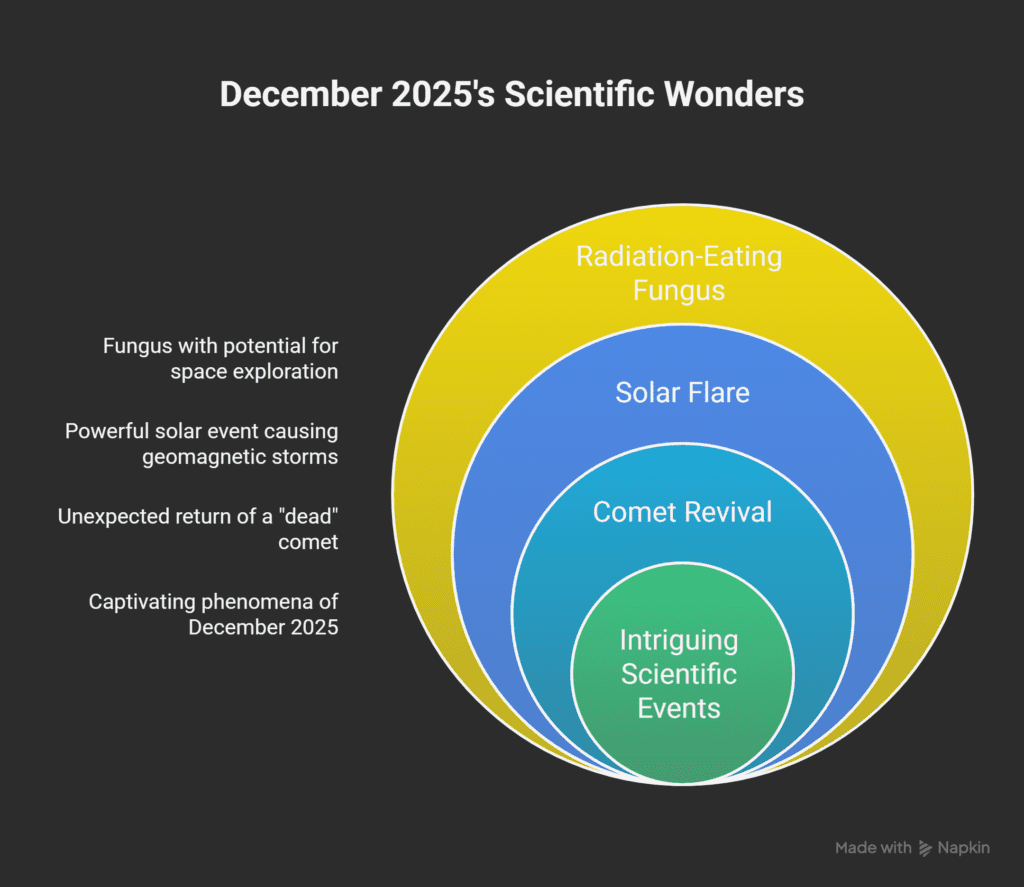
1. The Ghost of Comet ATLAS The first chaos
Do you remember comet ATLAS? Back in 2020, we were all hyped that it was going to be the “Comet of the Century,” and then it just… crumbled. It fell apart as it got close to the Sun. I remember standing in my backyard with my telescope that spring, trying to spot it, and seeing nothing but a faint, disappointing smear.
Well, it turns out ATLAS isn’t done with us.
In a twist that has astronomers scratching their heads, the “dead” remains of the comet—now reclassified as interstellar object 3I/ATLAS—just woke up. New images from Hubble show it venting gas and dust again.
This is a big deal because comets aren’t supposed to have a second act. Once they break up, the show is usually over. The fact that this thing is active again suggests it’s packed with weird, super-volatile ices we don’t fully understand yet. It feels a bit like a ghost from deep space decided to swing by and say, “I’m not dead yet.”
2. The Sun Just Threw a Curveball the second chaos
If your GPS acted weird yesterday or your high-frequency radio cut out, you can blame sunspot AR3912.
On December 1st, the Sun let out a massive X-class flare. We are nearing the peak of the solar cycle, so we knew things would get rowdy, but this was a big one. It triggered a G3 geomagnetic storm almost immediately.
While I was drafting this article, my phone actually buzzed with a magnetic storm alert. I stepped out onto my porch, and even though I’m not near the Arctic, I could see faint ribbons of green dancing over the hills.

It’s a double-edged sword. On one hand, satellite operators and power grid managers are sweating bullets right now. On the other hand, nature is putting on the best light show on Earth. If you have clear skies tonight, go outside. Seriously. The Sun is shouting at us, and it’s beautiful.
3. The Mushroom That Eats Radiation the third chaos
Okay, this is my favorite story of the week, and also the most “sci-fi.”
Scientists have been staring at a specific black fungus growing inside the Chernobyl Exclusion Zone for years. It’s called Cladosporium sphaerospermum, and it does something impossible: it feeds on radiation. It uses gamma rays the way plants use sunlight.
The news this week is that we finally have solid data from the International Space Station proving we can use this stuff to protect astronauts. A layer of this fungus—just 21 centimeters thick—blocked a significant chunk of cosmic radiation in orbit.
Think about how wild that is. The very thing that makes Chernobyl a disaster zone is fueling life that could help us get to Mars. NASA is already looking into “living shields” for lunar habitats. Imagine a spaceship hull that grows, heals itself, and eats the radiation trying to kill the crew.
In Conclusion,
When you look at these three stories together—a zombie comet, a solar storm, and a radiation-eating fungus—you realize how resilient the universe is. Things break and come back together. Life adapts to impossible conditions. The Sun reminds us who is really in charge.
Want to continue exploring the cosmos? Click here