
Medical disclaimer: This article is for general information only. It is not medical advice, a diagnosis, or a treatment plan, and it is not a substitute for care from a qualified health professional. Do not ignore professional advice, and do not delay seeking it, because of something you read here. If you may be having a medical emergency, contact local emergency services. Please also read our full Disclaimer.
Artificial intelligence is already used in parts of medicine, especially in reading images and in research. It is also easy to overstate. This article describes a few areas where AI is genuinely being studied or used, and it stays close to what official cancer and public-health pages actually say. It is not a review of any one product, and it is not a reason to change a treatment plan on your own.
What “AI in medicine” usually means
In practice, the phrase often refers to software that finds patterns in large sets of data: medical images, lab results, health records, or research papers. Some tools are designed to flag something for a clinician to review. Others are used behind the scenes in research, for example to sort images or to generate hypotheses. That is different from a system that “decides” a diagnosis or writes a prescription without a person in the loop.
Even when a tool is accurate in a study, it may work less well in a new hospital, on a different machine, or with patients who were under-represented in the original data. A cautious headline is usually closer to the truth than a claim that AI has already replaced a specialist.
Imaging is the most concrete example
Breast screening is a useful case because official pages discuss both the promise and the open questions. The U.S. National Cancer Institute notes that digital breast tomosynthesis (3D mammography) combined with standard mammography is better at finding tumours than standard mammography alone, but that it is still unknown whether this reduces deaths from breast cancer — a question the TMIST trial was designed to study. That is about a type of imaging, not about AI as such, and it is a reminder that “finds more things” and “saves more lives” are not automatically the same result.
NCI’s explainer on dense breasts also lists questions researchers are asking, including whether computers and artificial intelligence can identify features on mammograms, beyond conventional breast density, that improve the prediction of breast cancer risk. That is a research question, not a claim that such systems already outperform standard care in every clinic. If an imaging centre uses software to assist a radiologist, a patient can ask who reviews the result and what happens when the software and the clinician disagree.
Treatment plans, drug research, and telemedicine
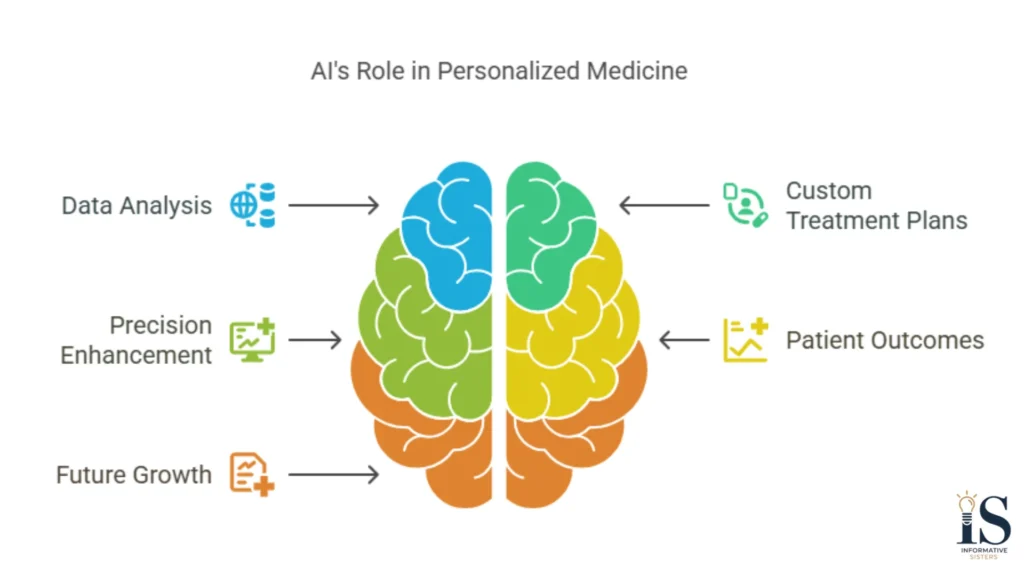
There is serious research on using algorithms to help match treatments to information about a tumour or a patient, and on using computation in parts of drug discovery. Those are active fields. This article does not repeat vendor claims about how many years or dollars are “saved,” and it does not claim that AI “drove COVID-19 vaccines to market.” Those statements are easy to get wrong if they are not tied to a specific, checkable source.
The same caution applies to chatbots that offer health advice. A conversational tool can summarise public pages, and it can also miss context, invent a reference, or give advice that is wrong for the person asking. It is not a clinic, and it should not be used as one. Official organisations sometimes publish their own symptom or information tools; those are a better starting point than an undated thread or an unattributed chatbot answer.
What a patient can usefully ask
If AI or “decision support” software is part of your care, questions that stay on solid ground include:
- Is this tool used to assist a clinician, or to generate a result that is not reviewed?
- Is the software cleared or authorised for this use by the relevant regulator in your country, if that applies?
- What happens if the software output and the clinician disagree?
- Is my data kept within the clinic’s systems, and is it used to train a model?
Those questions do not require you to understand the model. They are about responsibility, review, and privacy. Screening and treatment choices should still be made with a qualified professional who knows your history.
The honest summary
AI is a set of tools that can help with pattern-heavy work in medicine, especially imaging and research. Some of those tools are already in use; some are still being tested; and some marketing claims run ahead of the evidence. A previous version of this post leaned on broad, weakly sourced statements. This rewrite puts the emphasis back on official, modest language: what is being studied, what is already known, and what a patient might ask.
How this fits with screening advice you may already have
If you are making a personal decision about a mammogram or another test, official pages are more useful than a general AI article. NCI summarises current U.S. Preventive Services Task Force advice for average-risk screening, and it explains that people at much higher risk may be offered a different schedule. Those recommendations can change, and they may differ outside the United States. They also do not depend on whether a clinic uses a software assistant.
The same modest standard should apply to any “personalised treatment” claim you see in a news story. Ask what was actually measured — a better image, a shorter analysis time, a change in deaths or hospital stays — and whether an independent group has reviewed it. If the story cannot point to a paper, a trial, or a regulator’s page, treat it as unfinished.
Sources
The pages below were opened and checked while this rewrite was prepared (21 November 2026, Asia/Calcutta). Official figures and rules can change. If a live page differs from what is summarised here, follow the official page.