
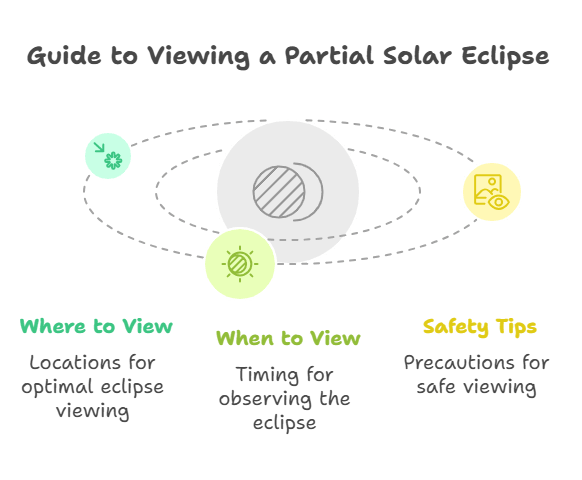
A partial solar eclipse is easy to get wrong in two different ways. One is to treat it as a once-in-a-lifetime emergency you must watch at all costs. The other is to glance up at the Sun as if a missing sliver of the disc had made it safe. This article is a general safety and viewing guide, based on NASA’s eclipse safety pages. It is not a notice about an eclipse happening tomorrow.
What a partial solar eclipse is
In a solar eclipse, the Moon passes between Earth and the Sun and blocks part or all of the Sun’s bright face as seen from places along the alignment. In a partial eclipse, the Moon covers only part of the Sun. An annular eclipse, when the Moon is too far from Earth to cover the Sun completely, leaves a bright ring. A total solar eclipse is different again: for a short time, along a narrow path, the Moon fully covers the Sun’s bright face. NASA’s safety advice is not the same for all three, which is why the label on the event matters.
The central safety rule
NASA’s basic rule is simple. Except during the brief total phase of a total solar eclipse, when the Moon completely blocks the Sun’s bright face, it is not safe to look directly at the Sun without specialised eye protection designed for solar viewing. During a partial or annular eclipse there is no period of totality, so it is never safe to look directly at the eclipse without that protection.
Regular sunglasses are not enough, no matter how dark they are. NASA says safe solar viewers — often called eclipse glasses or handheld solar viewers — are thousands of times darker and ought to comply with the international standard ISO 12312-2. NASA does not approve any particular brand. Inspect glasses or viewers before use and throw them away if they are torn, scratched, or otherwise damaged. Children should be supervised.
A second, easy-to-miss hazard involves cameras, binoculars, and telescopes. NASA warns that viewing any part of the bright Sun through a camera lens, binoculars, or a telescope without a special-purpose solar filter secured over the front of the optics will instantly cause severe eye injury. You must not look at the Sun through those devices while wearing eclipse glasses either: the concentrated rays can burn through the filter. Filters for optics are a different product, and NASA says you should seek expert advice from an astronomer before using one.
A safe way to watch if you do not have eclipse glasses
If you do not have a safe solar viewer, NASA recommends an indirect method, which does not involve looking at the Sun itself. A pinhole projector is the usual example: a small hole in a card projects an image of the Sun onto a nearby surface. You stand with the Sun at your back and look at the projected image, not through the hole at the Sun. A colander or similar item with small holes can project many little crescent Suns onto the ground during partial phases. NASA also describes a simple box projector: foil with a pinhole on one side of a cardboard box, white paper on the inside, and a viewing hole in the box.
If you are ever on the path of totality
Only in a total solar eclipse, and only during totality, does NASA say you can look at the eclipse directly without a solar viewer. You should still use eclipse glasses or a handheld viewer during the partial phases before and after totality. NASA’s test is practical: it is safe to look without a viewer only when you can no longer see any part of the Sun through the glasses. As soon as a little of the bright Sun reappears, the glasses go back on.
That exception does not apply to partial or annular eclipses at all. If someone tells you it is safe to glance at a partial eclipse because “most of the Sun is covered,” that is not NASA’s advice.
Skin, comfort, and planning
Even during a partial eclipse the Sun is still very bright. NASA notes that if you watch an entire event you may be in direct sunlight for hours, and it recommends sunscreen, a hat, and protective clothing. Check official eclipse maps and local timing from a source such as NASA close to the date. Weather, latitude, and the type of eclipse all change what you will actually see. This post does not list a next-eclipse date, because those dates should be taken from a live official page when you are ready to plan.
Why a “smaller” Sun is still unsafe to stare at
It is tempting to think that if the Moon has covered half of the Sun, the light must be half as dangerous, or that a thin crescent is as gentle as a sunset. NASA’s rule does not work that way. During a partial or annular eclipse, part of the Sun’s bright face is still in view. That remaining photosphere is still intense enough that NASA says direct viewing without proper solar filters is never safe in those events. The dimming you notice in the landscape can also be misleading, because your eyes may adjust to the lower general light while the uneclipsed portion of the Sun remains damaging to look at.
That is also why “just a quick glance” is a poor plan, and why phones and cameras are not a shortcut. If you want a photograph, the same front-mounted solar filter rules apply to the lens. If you are not set up for that, enjoy the changing light, the pinhole crescents under a leafy tree or a colander, and the official maps of who will see the eclipse — and leave the direct view to people with the right glasses or to the projection method.
If you remember only two sentences from NASA’s page, make them these: do not look at the Sun without solar viewers that meet the proper standard, except during the brief totality of a total eclipse; and never combine ordinary eclipse glasses with binoculars, a telescope, or a camera lens.
Sources
The pages below were opened and checked while this rewrite was prepared (21 November 2026, Asia/Calcutta). Official figures and rules can change. If a live page differs from what is summarised here, follow the official page.