

Introduction
There’s something almost primal about watching a rocket streak into the sky. It’s a mix of human ambition, engineering, and raw power that never gets old. If you’re in Southern California, you’re in luck: Vandenberg Space Force Base is one of the most active launch sites in the country, with new missions going up on a regular basis.
This guide covers everything you need to plan a viewing: how to find the current launch schedule, the best public viewing spots, and what to actually expect once countdown hits zero.
How to Find the Next Launch Date
Vandenberg launches happen often enough that exact dates change frequently, so rather than list one here, check a live tracker before you head out. Two reliable options are the Space Launch Now app and the Next Spaceflight website — both show upcoming Vandenberg missions with countdowns and real-time delay updates.
Most Vandenberg missions launch from Space Launch Complex 4E (SLC-4E), near Lompoc, CA. Launch times listed anywhere are always targets — weather, technical checks, or range safety concerns can push a launch back by hours or days, even at the last minute. Always confirm the time the morning of, not the night before.
Where to Watch the Launch, Safely and Legally
Unlike Cape Canaveral in Florida, Vandenberg doesn’t have a public viewing center inside the base. There are several great spots nearby that offer legal, unobstructed views. Here are the top three.
Ocean Beach Park, Lompoc
About 5 miles from SLC-4E, this flat, open beach gives you an unobstructed view south, with easy parking. Arrive at least an hour early to get a good spot, and bring a blanket and warm layers — it gets cold before dawn.
Vandenberg Village Overlook (Highway 1)
About 7 miles out, this spot sits at a higher elevation with less light pollution. Parking is limited along the roadside, so be careful not to block driveways or private property.
Jalama Beach County Park
About 17 miles away, this is the farthest option but has an iconic coastal setting — great for pairing a launch with sunrise. It’s best used on clear nights, since the extra distance makes visibility more sensitive to fog or haze.
One important note: never trespass onto Vandenberg property. It’s an active military installation, and unauthorized entry is both illegal and unsafe. Stick to public roads and parks.
What to Expect During the Launch
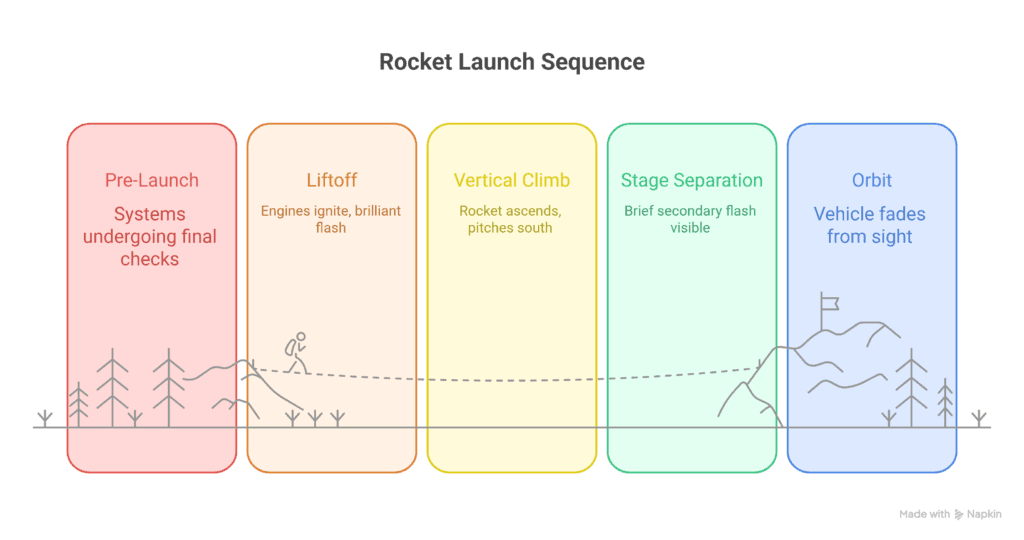
If you’ve never seen a night or pre-dawn launch, here’s roughly how it unfolds:
- T-10 minutes: Final systems checks. The sky is still dark, which makes for the best visibility.
- Liftoff: A blindingly bright flash as the engines ignite — far brighter than a stadium floodlight.
- First 30 seconds: The rocket climbs straight up, then begins its “pitch” maneuver, angling south over the Pacific.
- 1–2 minutes: Stage separation appears as a brief secondary flash.
- 3–4 minutes: The rocket climbs out of sight, often leaving a glowing ion trail behind.
Pro Tips for First-Time Viewers
- Check the weather first. Coastal fog is Vandenberg’s number one launch spoiler — clear skies mean the best visibility.
- Bring a red-light flashlight. It preserves your night vision while you’re setting up.
- Use a launch tracker app. Space Launch Now or Next Spaceflight will give you live countdowns and delay alerts.
- Be patient. If a launch scrubs, a backup date usually follows within 24 to 48 hours.
- Have a backup plan. SpaceX streams every launch on YouTube, often with onboard camera views you’d never get from the ground.
Why Vandenberg Matters
You might wonder why California, not Florida, hosts so many of these launches. The answer comes down to orbital mechanics. Vandenberg’s coastal location lets rockets fly south over open ocean, which is exactly what’s needed to reach polar or sun-synchronous orbits.
Satellites in these orbits pass over Earth’s poles, letting them image the entire planet as it rotates beneath them. That makes Vandenberg ideal for weather monitoring, Earth observation, and Starlink coverage in high-latitude regions like Alaska and Scandinavia. The U.S. Space Force reported 23 launches from Vandenberg in 2024 alone, making it the second-busiest launch site in the country after Cape Canaveral — and its role keeps growing as demand for space-based infrastructure increases.
Conclusion
Whether you’re a local stargazer or just visiting California’s Central Coast, catching a Vandenberg rocket launch is a genuine bucket-list experience. Check a live tracker for the next scheduled mission, pick your viewing spot, pack a thermos, and get ready to watch human engineering light up the sky.
Have you seen a Vandenberg launch before? Share your favorite viewing tip in the comments — we’d love to hear it.
Hungry for more space facts? Browse our Science category for more, or check Space Launch Now for the current Vandenberg schedule.