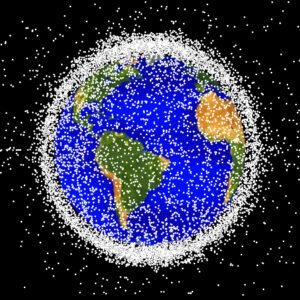


Space is getting more crowded every year. As of 2026, there are tens of thousands of tracked objects in orbit around Earth — active satellites, dead ones, spent rocket stages, and millions of smaller fragments too small to track individually. Scientists have a name for the nightmare scenario this creates: Kessler Syndrome. It’s a real, studied risk, not science fiction, and understanding it explains why space agencies are suddenly obsessed with “space junk.”
What Is Kessler Syndrome?
Kessler Syndrome is named after NASA scientist Donald J. Kessler, who first described the concept in 1978. The idea is straightforward but alarming: if there’s enough debris in orbit, a single collision between two objects creates thousands of smaller fragments. Each of those fragments can then collide with something else, creating more debris — a chain reaction that could, in a worst-case scenario, make entire orbital bands too dangerous to use for satellites, spacecraft, or crewed missions.
It isn’t a single dramatic event so much as a slow-building tipping point. The more objects in orbit, the higher the odds of a collision; the more collisions, the more debris; the more debris, the higher the odds of the next collision.
Has It Already Started Happening?
In a limited sense, yes. There have already been real collisions in orbit — most notably in 2009, when a defunct Russian satellite collided with an active Iridium communications satellite, destroying both and creating thousands of new tracked fragments. China’s 2007 anti-satellite missile test did the same thing deliberately, adding one of the largest single debris clouds in orbital history.
These events didn’t trigger the full cascading scenario Kessler described, but they demonstrated that the mechanism is real. Every major space agency now tracks debris fields from both events as an ongoing collision risk for other satellites.
Why It Matters More Now Than in 1978
When Kessler first proposed this idea, there were a few hundred satellites in orbit. Today, low Earth orbit alone holds well over ten thousand active satellites, driven largely by the rise of satellite internet constellations. More objects in the same orbital bands means more potential collision pairs, which is exactly the condition Kessler warned would eventually make the syndrome self-sustaining.
This is also why deorbiting old satellites, designing spacecraft to burn up safely at the end of their life, and tracking debris in real time have become standard practice for space agencies and private launch companies alike — not out of caution for its own sake, but because the physics genuinely gets worse with every launch if nothing is done to manage it.
What’s Being Done About It
- Tracking networks — organizations like the U.S. Space Surveillance Network monitor tens of thousands of objects and issue collision warnings to satellite operators.
- Deorbit requirements — many space agencies now require satellites to be designed to deorbit and burn up within 5–25 years of the end of their mission.
- Active debris removal — companies and agencies are testing spacecraft designed to capture and deorbit dead satellites and large debris fragments.
- Collision-avoidance maneuvers — satellites, including those in large constellations, routinely perform small orbital adjustments to dodge tracked debris.
None of this makes Kessler Syndrome impossible — it just means it’s being actively managed rather than ignored. Whether that management keeps pace with the rate of new satellite launches is one of the more consequential open questions in modern spaceflight.